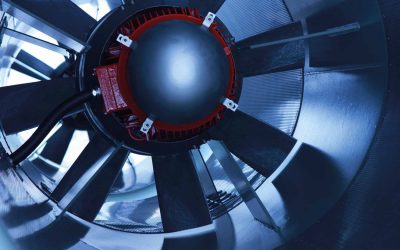
Fan diagram shows the performance of the fan under ideal conditions, depending on how the fan is installed and the structure of the system, it may not be possible to reach the performance in the fan diagram.
Fans installed in less good systems probably give a worse performance than expected and at a higher noise level.
Friction
Fans move air from one point to another and create a pressure increase that overcomes flow resistance. The flow resistance is the friction between the air particles over surfaces and against each other. This resistance increases with the speed of the air. Air with high velocity and a lot of turbulence has a higher resistance than slow, non-turbulent air.
In order to overcome the resistance, energy must be supplied.
Sound
Sound is created by pressure differences that are picked up by our ears. Turbulent air creates pressure differences and therefore gives rise to sound.
A perfect fan installation has non-turbulent air entering the fan inlet and no obstructions near the outlet.
Installations with sharp bends (90 degrees) give rise to turbulence and losses, so always aim for smooth transitions.
Some examples of things that improve a fan installation are:
- Inlet cone
- Smooth transition between fan cover and pipe system
- Splitter with flow-adapted profile after the fan (not a T-pipe)
Control
It is not always that the entire capacity of the fan is needed constantly, in which case it is wise to review the possibilities of installing a frequency converter.
With a frequency converter, it is possible to adapt the fan’s performance to the actual need and can enable large cost savings in electricity consumption during the fan’s lifetime.
At installation
When installing and before starting up a new system, it is important to verify that the fan is mounted correctly and that the system has been designed correctly.
Below are some guidelines.
Check:
- Distance between fan wheel and cover
- No thouching of impeller and casing anywhere
- Correctly aligned fan and pipe system
- Foundation
- Fan
- Flexible conections
- Nearby piping system
- Even load on anti-vibration mounts
- Visual check of depression
- Correct installation
- Safety switch
- Safety Chains (Impulse Fans)