To calculate the size of the fan’s motor as well as the fan’s starting performance, the fan’s starting time needs to be calculated.
The starting time tells how long it takes the fan to reach 100% performance from standstill.
The starting time is determined by the increasing torque, which is equal to the difference between the engine torque and the counter torque from the mass inertia of the fan wheel.
The engine’s torque curve can vary considerably from case to case, despite existing regulations. For starting torque, for example, the VDE 0530 standard allows a tolerance of −15% to +25%.
For motors with rotor class 16, the starting time is approximately:
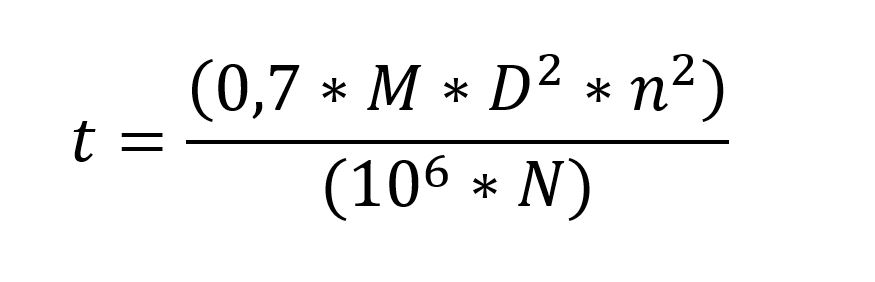
Where n is the fan speed in rpm, N is rated power in kW, M is the mass of the fan wheel in kg and D is the diameter of the fan wheel in meters.
With belt drive, n2 is replaced by nfan*nmotor i.e. the factor between the speed of the fan and the motor.
If a motor with a lower starting torque is used, the calculated time must be multiplied by 1.2 for rotor class 13 and 1.9 for class 10.
Axial fans
In general, relatively long start times should be expected for all axial fans that have a lower speed than the motor, e.g. in case of belt drive.
In the case above and also in other cases, the installation of relays for extra heavy starting may be necessary.
Centrifugal fans
A radial fan is, as a function of its design, a relatively high inertia machine.
This becomes particularly noticeable with large fan wheels at low speed, i.e. often with a motor with relatively low power and a small torque.
Therefore, a start time check should be done, at least for all fans that have a lower number of revolutions than the motor, for all motors over 10 kW.
The short relay times commonly used today will in many cases still make it necessary to use relays for extra heavy starting or centrifugal couplings.