The performance curves of axial fans have a more or less pronounced region of instability, due to its shape which is often called a saddle. In the area B − C (See the figure below), a small increase in the flow resistance coefficient will cause a significant decrease in flow combined with a simultaneous decrease in the pressure produced by the fan. If possible, a fan’s operating point should be placed in its normal operating range A − B, where it has the highest efficiency.
The effect of the saddle can be illustrated using the figure below which shows three operating points of a fan. They are determined as intersections of its performance curve with three different airflow curves. These often follow the rule:

where C1, C2, C3 are the flow resistance coefficients. The required pressure increases with the square of the flow through a system.
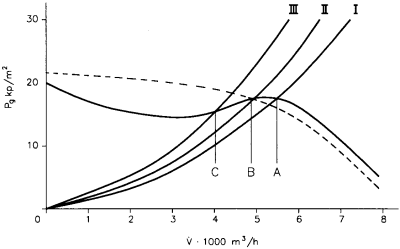
If we start from curve I and increase the coefficient by 20%, we get curve II. The power at the new operating point, defined as the product of flow and total pressure, is 10% lower than before. If the coefficient is increased once more by 20%, we get curve III. The operating point now falls in the saddle and the reduction in power is in the example shown 37%.
When fans operate to the left of point B, flow separation on the blades can cause them to vibrate significantly, eventually leading to fatigue. Especially for fans operating between points B and C, the so-called pumping can occur, where the operating point on the curve is subject to travel continuously along the curve. This can worsen the vibrations.
To prevent flow separation and pumping, our fans can be fitted on request with anti-stall rings which means that the fan curve will stabilize to the dashed line with greatly reduced vibration levels.